
Dawn thinks I’m nuts, but I’m making my own set of oars. Specifically, I’m building what I call Michalak Oars. (Jim Michalak acknowledges that he based his design on Pete Culler’s oars, so Gavin Atkin calls them Culler-Michalak oars.)
One factor is cost, where I’m splurging on 1 × 8 pine at $22 per board but even the cheapest oars on Amazon or at like Cabela’s are twice that, but furthermore my oars are hopefully going to be better than those more expensive oars. As Atkin says:
The Culler-Michalak method produces a pair of oars at a fraction of the price you will be charged for a single badly balanced and clunky ready-made oar bought from a yacht chandler. So these real paragons among oars are cheap as well as right for the purpose.
Atkin, G. (2008). Ultrasimple boatbuilding: 17 plywood boats anyone can build. Camden, Me.: International Marine/McGraw-Hill.
So I’m definitely going with the great Jim Michalak on the matter.

I am making one small change, though, in that I’m using 1 × 8 lumber instead of 1 × 6. I never could make the 1 × 6 size work for the parts in SketchUp. Atkin and Michalak both say it works, but I’m using 1 × 8 anyway, despite it being like $5 more per board. I’m spending $10 in insurance, I guess.

The President’s Day holiday weekend was great, having the three days, where I bought the boards and got them home on Saturday, got all the parts marked on the boards on Sunday, and cut out all the parts on Monday.
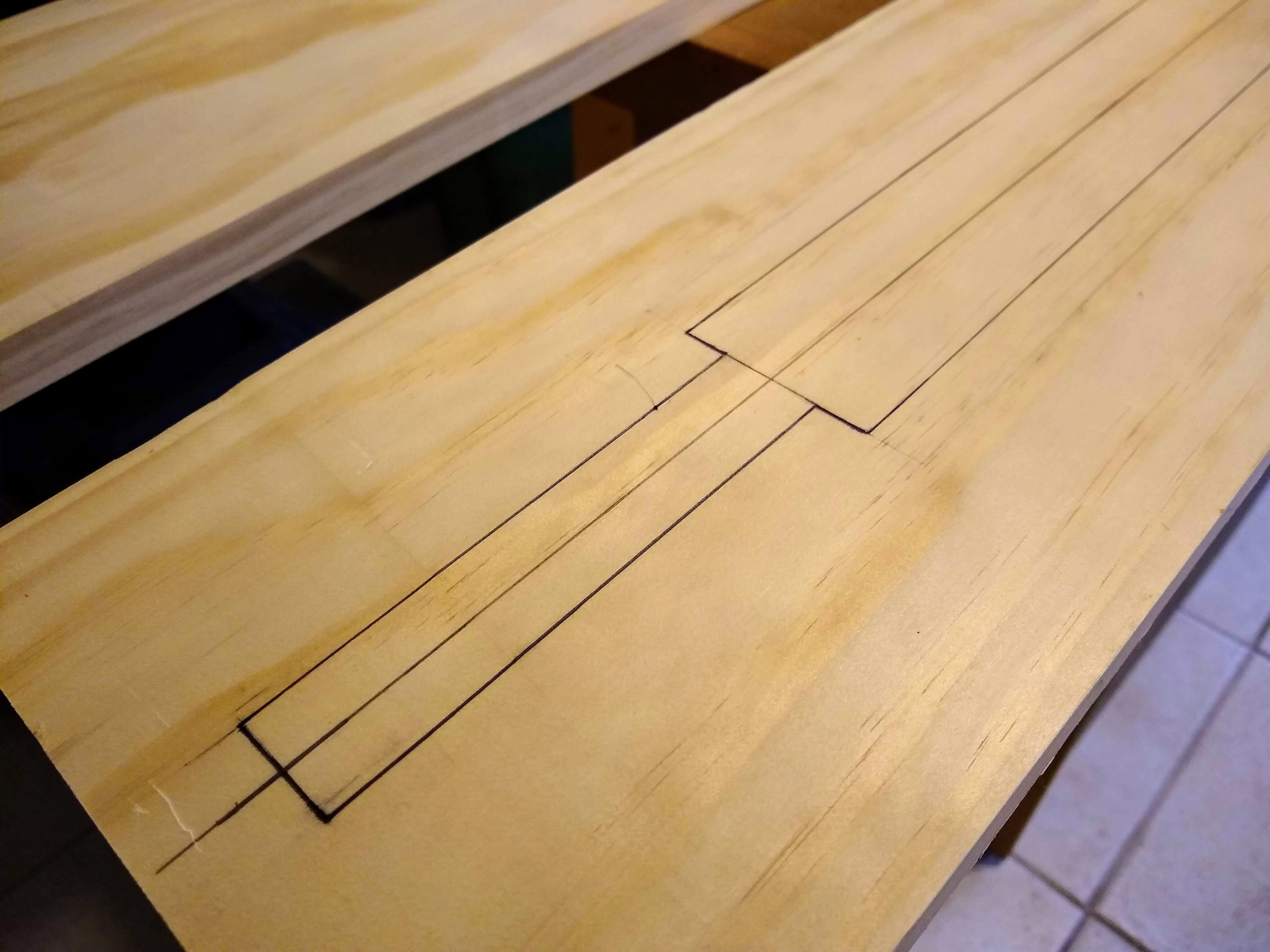
My local Home Depot only had 4 eight-foot 1 × 8 boards from which to choose my 2, so I got the straightest 2 of the bunch as best I could. I had to wait almost a half hour to even get into the aisle where the boards were stacked, as it was blocked off for … whatever. Maybe carting in more stock or something. I was over buying some rope while I was waiting, which itself took the longest time to get somebody to cut it with the hot knife for me. Sigh.

But anyway I got the pine home and marked it up. It was quite a fun project, as it was in the relatively roomy (and warm) basement instead of the cramped (and nowadays cold) garage. Dawn was off seeing the Maryland gymnastics team meet Rutgers, so I even had Pandora blasting some tunes. (I don’t usually listen to music while working, at least not while I’m using any tool of any kind. But I figure I can hardly get that injured if I’m distracted while wielding a pencil.)
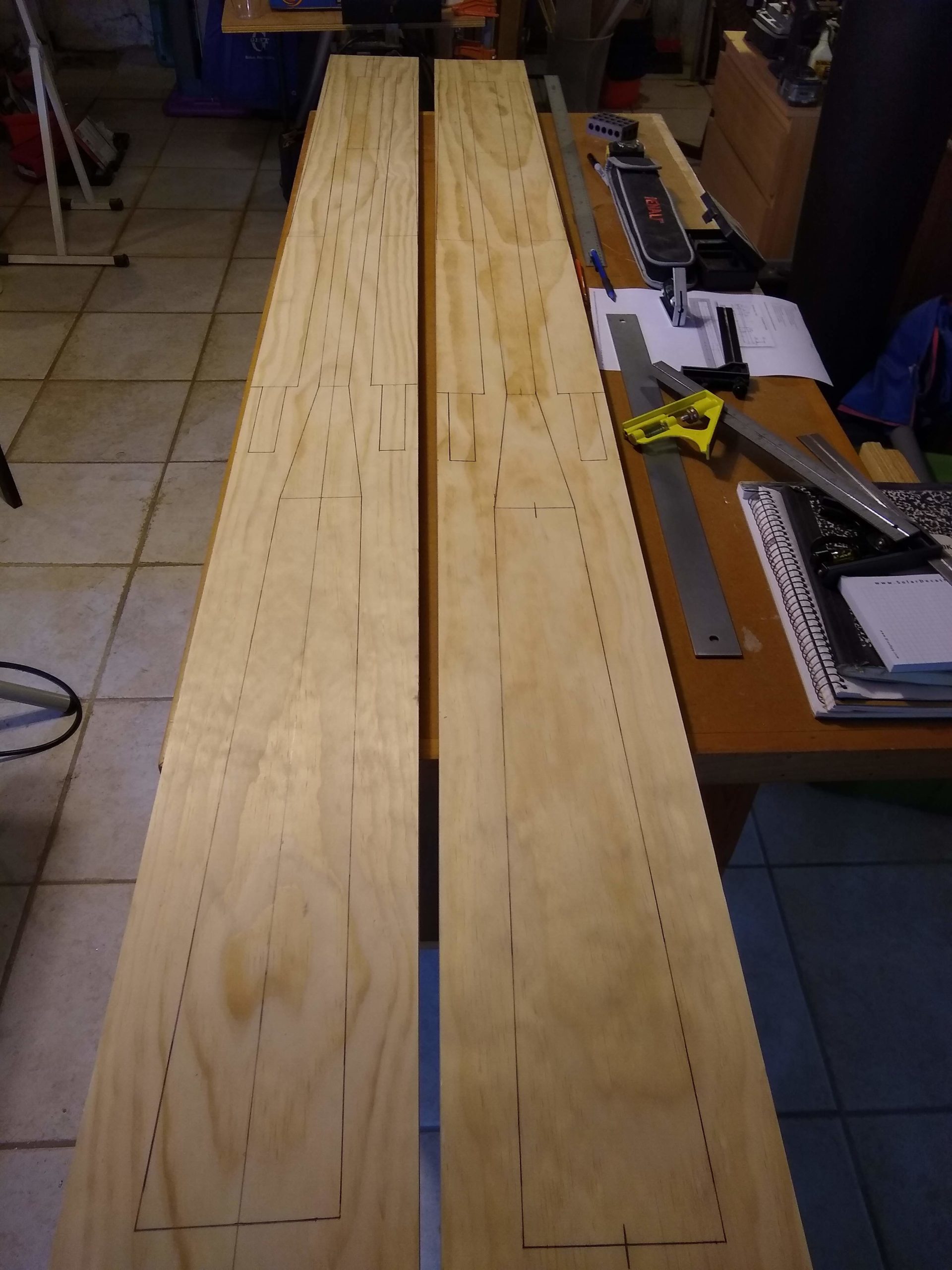
I measured and re-measured and checked my measurements over and over, patiently erasing plenty of errant lines as I plotted out the parts. The worst was when I drew the lower part of the loom an extra 1/8 inch, where I have no idea how I got that wrong, since it’s a plain 30″ length (although a taper from 2″ down to 1-1/4″). But pencil mistakes are not nearly as upsetting as saw mistakes.

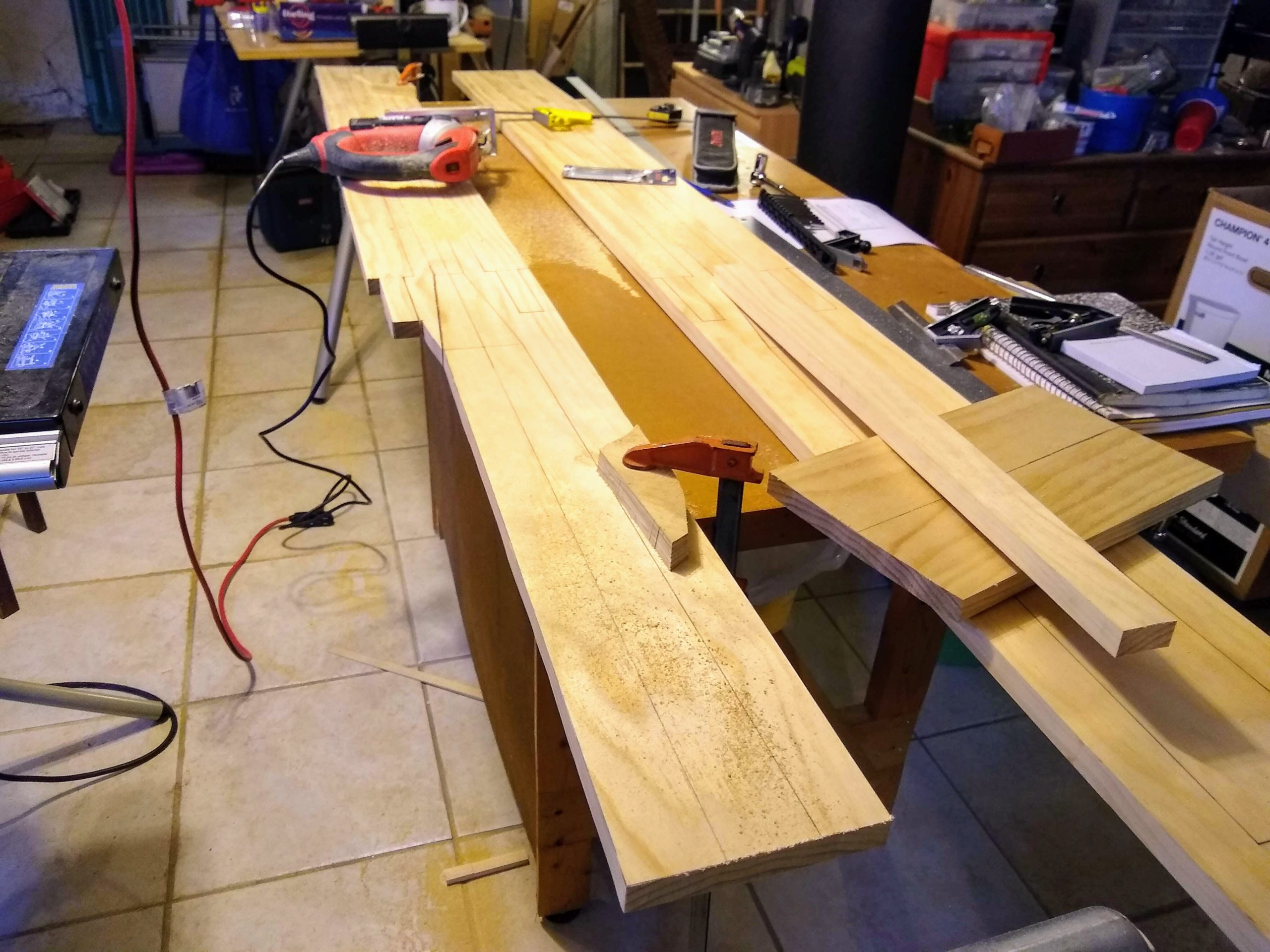
Cutting out all the parts was rather much more challenging. First was that I used a jig saw, where Michalak uses, and recommends, a band saw. He laments that not everyone has a band saw, but he uses one anyway. But, yeah, I don’t have a band saw. Even if I did, though, I guess I’d only have like a 9″ or 10″ bench top band saw, which I’m not sure about maneuvering an eight-foot board around on one of those.
He also says that some folks use a table saw instead, which I do have one of those. But I don’t really see how that would work. Maybe by separating the parts first with a jig saw and then using the table saw to cut out the parts proper? But that’s a lot of long angled cuts, which I can only imagine needs some sort of taper jig on the table saw, since you couldn’t use an angled miter gauge. No thanks.

So the jig saw wasn’t great, but it was what I could use. The biggest problem was holding the work on my work bench while cutting. That involved a lot of clamping on the edge of the bench, making all or maybe even just part of a cut, and then un-clamping and moving and re-clamping the piece.
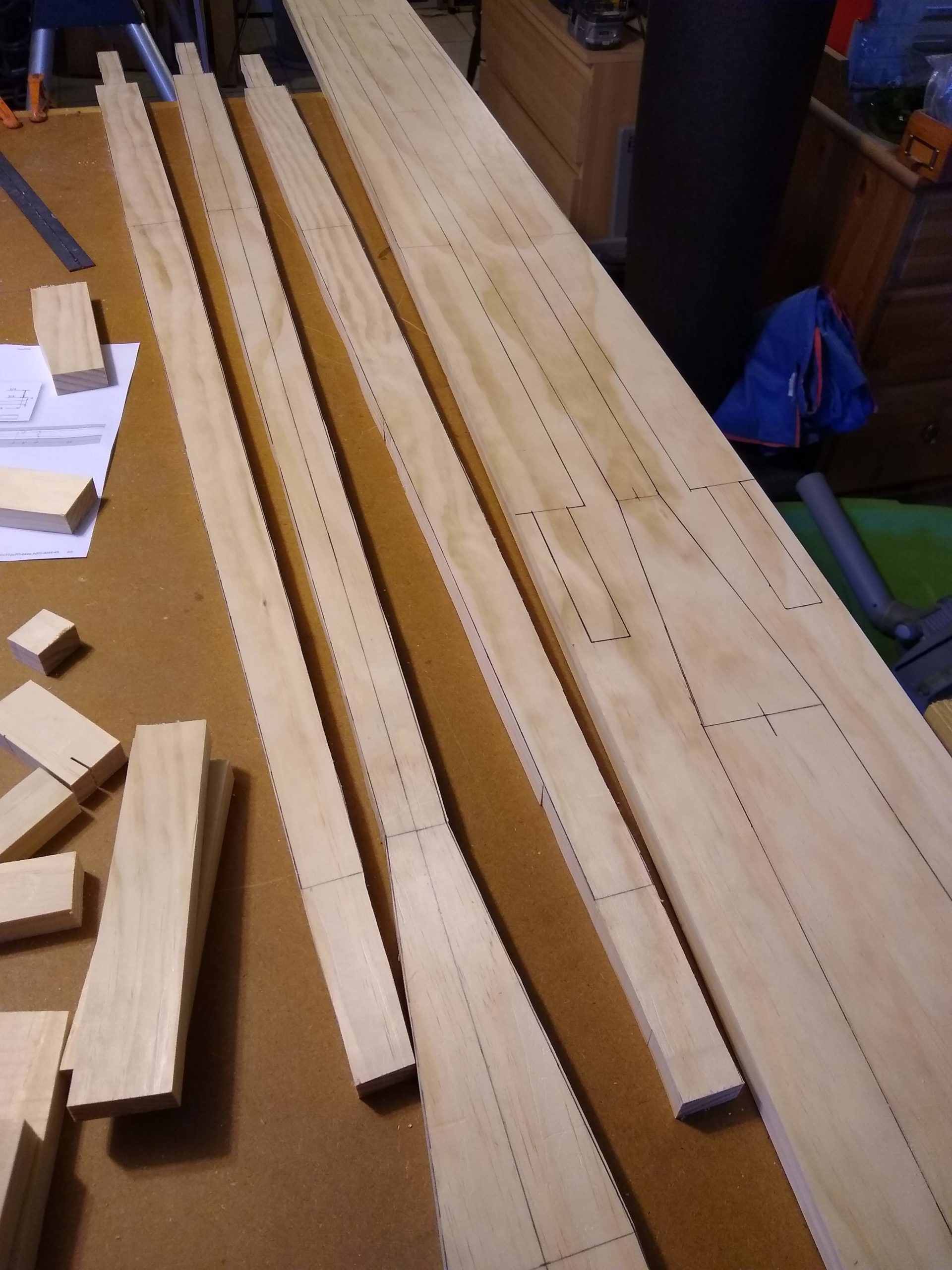
There was a lot of strategery involved. But it all got cut out.

Next steps are supposed to be gluing the 3-piece sandwiches together and then shaping the oars with plane and rasp and file. I’ve got some alternative ideas to help speed that along. Maybe. We’ll see.
Lesson 1: Circular Saw vs Jig Saw
I could have used my little 4-1/2″ circular saw, too. One advantage to that would have been being able to cut with the board stacked on some 2×4s instead of clamped to the edge of my work bench. But that would only have worked for some of the cuts, before the parts got too narrow to cut without clamping them to the bench.
Plus there were all of the cuts for the handle that are interior 90° angles that I couldn’t cut with a circular blade. Those needed the straight-blade jig saw. So even if I used the circular saw, I still would have needed the jig saw. So I just used the jig saw for all the cuts.
But the one thing that the jig saw did that the circular saw doesn’t do is flex. Some of my cuts weren’t true along some of the sides. But I was cutting conservatively on the waste side of the layout lines, so that’s not the biggest issue. There’s still a lot of final shaping to be done where I can fix all that.
I guess a Problem/error #1 for me was that I didn’t ask to see the whole specs on building materials, cut-outs plan, and final specs. Problem/error #2 was that I forgot to ask (or I’m forgetting to remember that I did ask but am now just forgetting the answer) whether the final purpose was that by meeting the building specs, exactly, you qualified to be in a “one-design” club that would meet periodically to race or just to associate for regattas for fun.
Since I binge read up to about the time of discussing primer paints, I think, but then haven’t kept up week by week, I missed the opportunity to question and challenge the 90 degree cuts at the end of the oars, which weakens the oar handles, compared to tapering the oars down to the desired oar handles diameter. It’s a lot easier to keep paring them down from too large than to add back, especially if throwing on rubber grips is not kosher.
The boat was designed by David Beede at Simplicity Boats for a contest over at Duckworks Magazine. I just liked the looks of it as well as all the instructions and pictures that Beede provided. Then I bought a book by Gavin Atkin that included this same boat with even more instruction and advice. So I decided to dive in and built it.
I don’t know if it’s a one-design for racing, if enough of them have been built for that. I don’t know if I’m ready for racing quite yet. I’ve never soloed in a boat, is pretty much why I decided to build my own boat. So I could take it out by myself whenever I wanted. Oh, and that would fit in my garage when it wasn’t out.
As far as the oars go, I just followed Jim Michalak’s design as best as I could. I’ve never rowed before, so I figured I’d learn as I rowed what works or doesn’t for me. The big square parts of the looms is for balance, as I understand it, but maybe also just for ease of construction. I sure hope a handle doesn’t just snap off, though. Yikes!